
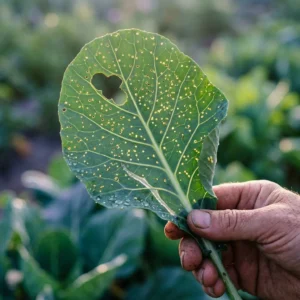
If you’ve noticed holes in your lettuce, kale, or collard leaves … or found entire plants nibbled down to stubs … you’re dealing with one of five common garden pests. The good news? Each pest leaves distinct clues that tell you exactly what you’re facing.
Learning to identify garden pests isn’t about becoming an expert overnight. It’s about recognizing the damage patterns on your leaves and understanding which simple steps will actually solve your specific problem. Once you know what to look for, managing pests becomes much easier.
Quick Guide: How to Tell What’s Eating Your Greens
Different pests create different types of damage. Here’s what to look for:
• Tiny holes scattered across leaves (like buckshot) = Flea beetles
• Irregular holes in leaf centers + slime trails = Slugs
• Random holes that start small and grow = Caterpillars (check undersides for tiny yellow eggs)
• Plants cut off at the base overnight = Cutworms
• Entire plants stripped in one night = Mammals (rabbits, deer, rats)
Once you identify which pest you have, you can take targeted action instead of guessing.
In this video, Stacey Murphy shows you exactly what each type of damage looks like in real garden conditions, using examples from her own greens. She demonstrates how to spot pest eggs before they hatch, shares the simple overnight test that tells you if you’re dealing with insects or animals, and explains why catching problems early—when you see just one or two small holes—makes all the difference.
The most valuable part? Seeing the visual differences between pest damage types, because that’s what tells you which solution will actually work.
Watch the full video 🎥 What’s Eating My Garden Greens? 5 Common Pests
How to Identify Flea Beetles on Garden Greens
Flea beetles create damage that looks like tiny holes scattered all over your leaves—Stacey describes it as looking like someone took a shotgun to them. These little black beetles are about the size of a pinhead and they jump like fleas when you get close, which is why you’ll often see the damage but never spot the pest itself.
Flea beetles target soft, tender young greens like baby kale and collards. Once your plants mature and the leaves get tougher, flea beetles usually lose interest.
How to manage flea beetles: Interrupt their life cycle by gently scuffling (disturbing) the top layer of soil where they lay their eggs and hatch larvae. This simple practice can significantly reduce future generations.
How to Identify Slug Damage on Greens
Slugs create irregular holes in the soft parts of leaves between the veins, usually eating from the center of the leaf rather than the edges. The telltale sign? Iridescent, sparkly slime trails on your leaves and soil.
Simple slug trap: Place an old piece of wood or board in your garden bed. Check underneath it at early morning dawn before the sun comes up. Slugs will gather under the board overnight, making them easy to find and remove before they can do more damage.
How to Identify Caterpillars (Cabbage Worms and Loopers)
Caterpillars create irregular holes scattered across leaves. The damage starts small when they first hatch and grows larger as the caterpillar gets bigger.
The key to staying ahead: catch them before they hatch. Those white butterflies (cabbage moths) fluttering around your garden are laying tiny yellow eggs on the undersides of your leaves.
Stacey demonstrates this in the video—she lifts a leaf and shows you exactly what those tiny eggs look like. If you spot them, simply brush them off. Once they fall to the ground, the emerging caterpillars can’t climb back up the plant.
Harvesting as prevention: If you harvest the outer leaves of your greens regularly, you remove eggs and small caterpillars before they can multiply. Stacey notes that when she sees big caterpillar populations, it’s usually because someone isn’t harvesting enough.
How to Tell If an Animal Is Eating Your Greens (The Overnight Test)
If your greens look fine in the evening but are half-gone or completely stripped by morning, you’re dealing with a mammal – rabbits, rats, or deer.
Mammals work fast and can demolish greens overnight. Insects take days or weeks to create visible damage.
The overnight test: If you’re not sure whether damage happened quickly or built up over time, remove all damaged leaves so you’re starting fresh. Check again the next morning. If previously undamaged leaves now have holes or bites, you have an animal visitor and need to consider barriers or relocating plants rather than focusing on insect management.
This simple diagnostic test helps you focus your efforts where they’ll actually work.
What About Ants and Aphids?
Ants typically aren’t eating your greens unless you’re in a tropical area with leaf cutter ants (which eat the edges of leaves in a very distinct pattern). In most climates, ants are beneficial—they pollinate cucumbers and squash and break down organic matter.
Aphids are very visible—small green or gray insects clustered on your plants. Cabbage aphids (which are gray) often gather deep in the center of plants during cooler months and breed quickly. The solution is simple: brush them off, spray them off with water, or wipe them off with your hands. They have a hard time climbing back up once removed.
One of the most reassuring things Stacey emphasizes in the video is this: every garden has pests. Every garden has diseases. It’s just part of growing food. The goal isn’t to eliminate every single pest—it’s to keep them in balance so they don’t overwhelm your plants.
Managing Pests Through Healthy Ecosystems
Every garden has pests. The goal isn’t elimination—it’s balance. When you maintain healthy soil and a healthy ecosystem, pests tend to stay in check naturally. Stacey compares it to our immune systems: when they’re strong, sicknesses don’t take over as easily.
Stacey shares creative strategies for managing pests without turning her garden into a fortress of netting and fences. For example, she grows spicy mustard greens and dandelion that the tree rats in her area won’t eat. She harvests outer leaves regularly to prevent caterpillars from settling in and multiplying.
Another option when dealing with persistent animal pests: don’t plant what they love to eat. Eliminate the headache by choosing varieties pests naturally avoid.
What to Do When You See Pest Damage
If you’re seeing pest damage, it doesn’t mean you’re failing. It means you’re growing food, and other creatures are noticing.
The key is catching problems early—when you see one or two small holes, not when half the plant is gone. That early observation gives you time to identify the pest and interrupt its life cycle before it becomes overwhelming.
Stacey emphasizes that every garden has different pest pressures. Your garden might have a couple of main pests; someone else’s garden will have different ones. Once you identify your specific challenges, you can create simple observation habits—checking undersides of leaves weekly, looking for slime trails, noticing when damage appears—that keep you ahead of problems.
In the complete video above, Stacey walks through all five common pests—including cutworms and aphids—and shows you real examples of damage from her own garden. She explains pest life cycles in a way that makes sense, and shares the simple observation habits that help you catch problems early.
You’ll learn exactly what to look for, when to take action, and simple prevention strategies that help you grow greens successfully—so you’re the one who gets to enjoy the harvest you’ve been working toward.
What are favorite, or not so favorite, visitors to your garden?





My experience with sprouting green beans has been slugs. If I grew the plants in a pot and either kept them there ot transplanted them into the ground right before they were ready to climb, the slugs didn’t seem to like them as much. I’m thinking because they were not as tender.
I pick off any caterpillars I find and throw them into the yard, hoping a hungry bird will find them.
I have an issue with bunnies eating things and squirrels digging in general. or digging up my pea seeds. Then the bunnies wouldn’t leave the pea plants alone. I found ceyenne pepper very helpful for the squirrels and pretty helpful for the bunnies, but you have to remember that bunnies will jump up and/or stand on their hind quarters, to reach a tasty plant. You also have to reapply often. Ultimately, what works the best for me is if I can plant bunny favorites out of their reach, like on my deck or in a high raised bed, most times.
its a beetle yellow and black strips
I planted Marigolds all around my vegetable garden in the North Coast of Westport, CA and also Garlic bulbs. These plants helped to keep the pests out!
I also put pine needles around my strawberries to keep the slugs and snails away! Pine needles also ADD Vitamin C, and give you even BIGGER strawberries. The snails and slugs do NOT like to crawl over these pine needles because these pine “needles” have a JAGGED edge! (I know that “Straw”berries have this name because people covered their berry patch with “straw,” but actually pine needles serve the same purpose and work even better! My neighbor who “shared” this idea with me: also shared his pine needles from all these Pine Trees he had growing on his property. Therefore, I tried his “idea” right away on my strawberry patch, and WOW, this was truly amazing~
Another “help” for strawberries I discovered in Mount Shasta, CA where again I had planted strawberries in an empty wooden planter that was already there} when I rented that house on 4 acres of land. That land was very RICH in nutrients because of the water that ran down the mountain nearby bringing with it} rich topsoil. Therefore, I did not have to fertilize anything…just supplied the watering during dry weather} which was also filtered through that mountain and this pumped well water was also the cleanest purest water I had ever seen.
But, I did have problems with the many birds and also squirrels both brown ground squirrels and grey tree squirrels eating my strawberries even while they were still “white” and hardly ripe. And so because of this, I then covered these strawberries with this “glittering” rainbow colored net I had purchased from a Nursery.
This “glittering” net then kept these various birds and squirrels (both grey tree and brown ground squirrels} OUT of my strawberry patch! This net that had this rainbow colored glitter on it was quite lovely too. My neighbors all “coveted it,” but the birds did not, and neither did these squirrels. But to make up with them: I would share my organic walnuts and sunflower seeds just as I did every morning with a whole flock of seventy Blue Jays!
This net also protected a Praying Mantis that kept my garden free of bugs! I discovered him living there when he was just a baby about 1/4 inch big… a very “tiny” fully developed Praying Mantis! Every time I watered that strawberry patch, I then offered to him a LEAF to jump on so that I could carry him out of this large planter before watering there with a hose. He would always jump on this “offered” LEAF,” and then he would sit on the LEAF, put his two “hands” together, close his eyes and “PRAY”… just as I lifted him out, and I then gently placed that leaf on the ground. After watering…I then lifted that leaf with him still sitting there… and, he then would jump into that protected strawberry patch again: which I then covered with that glittering strawberry net.
This happened every time I watered there over the years…And after about 3 years had passed… this same Praying Mantis was about 3 inches long…And always he would sit and PRAY with his “hands” together and his eyes closed while sitting on that leaf. And, the land there with just a little water added: gradually became so amazingly RICH with plants as well as wildlife.
I ADD here there was no Wi-Fi in that Mountainous Canyon and it
was also “free” from any cell towers or smart meter grids. WE kept that EMF Pollution OUT of that canyon, and it was then truly an area like the Garden of Eden. I could tell that the land had been worked in the distant past as a farm with a old chicken coop and up the long driveway stilled lined with failing heirloom rose bushes!
There were many old flowering bulbs deep underground that suddenly sprouted from just a little water! My neighbors “noticed” and came over and said, “WOW, three feet tall Irises…What did you put on them!?” and I said, “Uh, water.”
My flowering trees also came back, and these flowering fragrant trees were just COVERED with hundreds of butterflies that flew down that canyon during that first Spring! Whelp, after this people within that canyon suddenly became enthusiastic gardeners… planting roses, and crops, and putting in new chicken coops and tending their fruit trees again. And the wildlife became much more abundant too.
I had a whole “tribe” of black lizards that lived in a shelf of rocks towards the back of my land there. They would come and enjoy my garden, the rocks, sun, the plant shading, and the water too. And every Spring they would come to proudly show me their off-spring of new baby black lizards. These lizards were black, but they had these shimmering rainbow colors in the sunlight. Sometimes I would sing in my garden…and they they would suddenly appear out from under plants and rocks to enjoy the music!
And here I experienced a “cooperation” between wildlife plants and people like I had never witnessed before. Even these two herds of deer would not eat the flowers if I said to them “to eat these is o.k., but not those.” And the baby deer would “wag” their deer tails just like a dog would when they were happy!
There were mountain lions that visited the riverbed area of that canyon, and in the Fall we had wild black bears eating everything they could before their winter hibernation. But, I never witnessed anything “scary” even from these animals. There was a special “balanced”energy on that land so much so that it almost seemed sacred.
May God Bless Us All, In His Name,
Pamella Beth Morey, B.A., M.H. (Master Herbalist), Certified Iridologist, Health Counselor/Researcher 40+ years
How do you get rid of cutworms or prevent them next season?
We have crows who lift out sprouts, particularly soy beans. They like to take the seeds. We have reflective cds strung up. Ordered mylar tape too. Also have slugs and have run copper tape.That is helping. Recently a chard plant that had several leaves and well established was completely mowed. I do not know what did that overnight. A bird? Jays are another thing around. Also there are cats and squirrels digging. I have sticks and wood baracading where things are growing.So many pests. This year is the worst for it. Oh yes, we have those grey cabbage aphids and they require constant spraying with hose or safer. I bought praying mantis larvae. I do not know if they hatched. I have seen those zucchini beetles again recently and will definitely not grow that after they were terrible last year. So I do not have a great handle on all this. I have compost and amendments from Lane Forest. I will take suggestions! Btw I am in Oregon.
Your videos are very instructive and relevant. I appreciate your professional expertize.
Something is eating my green beans as soon as they come through the ground. Would that be cut worms?