You planted a garden.. You watered, weeded, and waited. And when harvest time came, you stood there looking at your beds thinking: Is this it?
If you’re wondering how to grow more vegetables in a small garden or how to increase garden harvest without adding more beds, you’re not alone. It’s one of the most common questions home gardeners ask—and the answer has less to do with space than you might think.
Maybe you got a few tomatoes. A handful of beans. Some lettuce that bolted before you were ready. Meanwhile, you see other gardeners pulling baskets of food from backyard gardens the same size as yours, food they’ll serve at dinner tonight, food they grew with their own hands, and you wonder what you’re missing.
Get ready to learn from expert gardeners at the Superfood Garden Summit that will change how you think about this: abundance isn’t about having more space. It’s about understanding the different ways you can garden in the space you already have … ways that work with nature, not against it. Ways that let you step into your garden and feel excited instead of overwhelmed.
What you’re about to read scratches the surface of a much deeper framework—one that answers the question every home gardener eventually asks: how do I grow more food without burning out?
Ready to go deeper? You are invited to join us for the Superfood Garden Summit that brings together expert gardeners who’ve spent years refining these exact strategies. You’ll learn how to plan for continuous harvests, which crops give you the most nutrition per square foot, and practical techniques that work in any garden size.

The answer isn’t about effort or even experience, it’s about approach. Most of us were never taught how to maximize yield from limited space. We learned to plant in rows, water when dry, and hope for the best. That works, but it leaves potential food ungrown and misses the deeper satisfaction of knowing you’re truly feeding yourself and your family from your own backyard.
The gardeners pulling in baskets of produce? They’re using different ways to garden … ways that layer plants strategically, time harvests intentionally, and build soil that does the heavy lifting.
How to Grow More Food Using Vertical Space and Interplanting
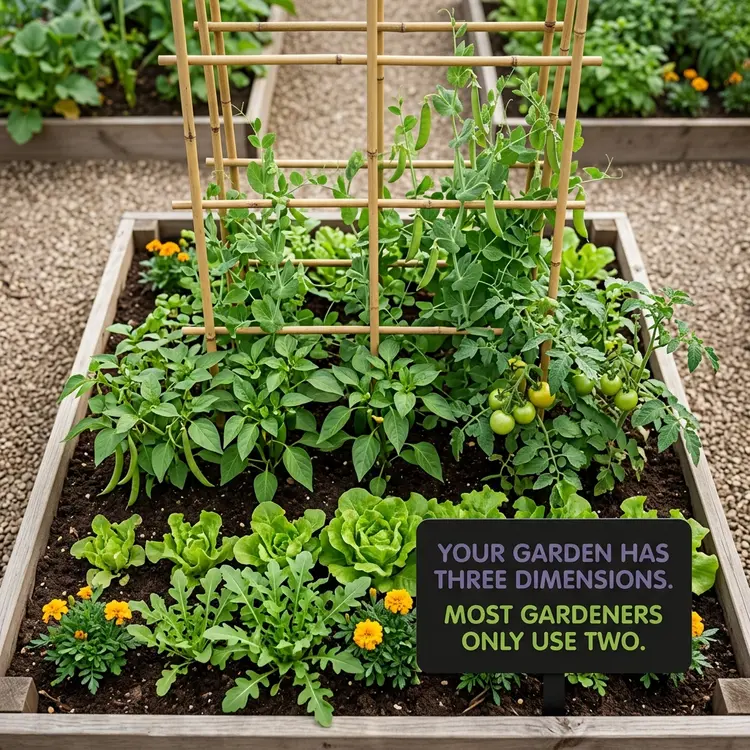
When you look at a garden bed, you’re probably seeing it in two dimensions: length and width. But your garden actually has three dimensions. The third one—vertical space—is where most home gardeners with limited space leave food on the table.
What is interplanting and how does it increase yield?
Interplanting means growing different crops together in the same bed based on how they use space and nutrients.
For example:
• Tall crops (like tomatoes or pole beans) grow upward
• Mid-level crops (like peppers or bush beans) fill the middle layer
• Ground covers (like lettuce or herbs) spread low and wide
When you plant these together, each one occupies a different layer. They’re not competing for the same space because they’re using different zones.
A classic example: plant lettuce at the base of your tomato plants. The lettuce grows in the cool shade while the tomatoes reach for the sun. Both plants thrive, and you harvest twice as much food from the same square footage. There’s something deeply satisfying about watching plants support each other this way—it’s gardening in harmony with how nature actually works.
How to Use Vertical Gardening to Maximize Space
Anything that vines or climbs can grow upward instead of sprawling across the ground.
Cucumbers, squash, peas, beans, and even melons can be trained onto trellises, fences, or stakes. This frees up ground space for other crops and makes harvesting easier. You don’t need fancy structures. A simple trellis made from bamboo poles or cattle panels works beautifully.
The result? You can grow two to three times more food in the same bed just by thinking in layers. And every time you harvest, you’ll feel that quiet pride that comes from truly understanding your garden.
How Do I Keep Harvesting Fresh Vegetables All Season Long?
One of the most common frustrations gardeners face is the “feast or famine” problem.
All your lettuce is ready at once. Then it’s gone, and you’re back to buying greens at the store.
Or your zucchini plants produce so much in two weeks that you’re giving it away to neighbors, but by August, the plants are done and you have nothing.
This happens when we plant everything at the same time and expect it to last all season.
Nature doesn’t work that way. Plants grow, mature, and finish their cycle. If you want food all season long, you need to stagger your plantings.
What is Succession Planting and Why Does It Work?
Succession planting means planting small amounts of the same crop every 2–3 weeks instead of planting it all at once.
Here’s how it works:
• Plant a short row of lettuce in early spring
• Two weeks later, plant another row
• Two weeks after that, plant another
By the time the first planting is finishing, the second one is ready to harvest. You create a continuous supply instead of a single burst.
This works beautifully for lettuce and salad greens, radishes, beans, carrots and herbs like cilantro and dill.
How to Extend Your Harvest by Staggering Varieties
Another way to extend your harvest is to plant early, mid-season, and late varieties of the same crop.
Tomatoes are a perfect example. An early variety might start producing in July, a mid-season variety in early August, and a late variety in September. You get tomatoes for three months instead of three weeks.
The same principle applies to broccoli, cabbage, and even fruits like strawberries.
The result? You’re harvesting fresh food consistently instead of dealing with overwhelming abundance followed by nothing. Imagine walking to your garden every week and coming back with something ripe and ready, that steady rhythm becomes a grounding part of your routine, a connection to the seasons and to real food.
What Makes Vegetable Plants Produce More Food?
A stressed plant produces less food. When a plant is struggling with poor soil, crowding, or inconsistent water, it puts energy into survival instead of fruit production.
Healthy plants produce more food, and they do it with less effort from you.
Why Soil Health Matters More Than Garden Size
Your soil is the foundation of everything that grows. Plants pull nutrients from the soil to build leaves, stems, roots, and fruit. If the soil is depleted, the plant can’t build what it needs.
Healthy soil creates strong roots, and strong roots create abundant harvests. When you work with your soil instead of fighting it, gardening becomes easier and more rewarding—less of a chore, more of a joy.
How to Start Maximizing Your Garden Yield This Season
You don’t need to implement every strategy at once. In fact, trying to do too much often leads to overwhelm, and overwhelm leads to giving up.
Start with one or two changes this season. Watch how they work in your garden. Build on what you learn. This is how you develop the kind of confidence that makes gardening feel less like guesswork and more like a conversation with your space.
Do a Few Things Well
Choose two or three crops you love to eat, and focus on growing those really well. There’s real satisfaction in mastering a few things deeply, in knowing you can grow incredible tomatoes or crisp lettuce or fragrant herbs, and serve them fresh from your garden to your table.
Learn their rhythms. Notice when they thrive and when they struggle. Adjust your approach season by season.
Mastery comes from repetition, not from trying everything at once.
Observe What Works
Your garden will teach you so much if you pay attention.
Notice which plants do well in certain spots. Notice which combinations seem to support each other. Notice how the timing of your plantings affects your harvest. These observations become your personal gardening knowledge, and that knowledge is what creates abundance over time.
Build Confidence Season by Season
Gardening is a long game.
Each season, you’ll understand a little more. Each year, your soil will improve. Each planting, you’ll get better at timing and spacing.
This is how experienced gardeners operate. They didn’t learn everything at once. They built their skills gradually, and that’s exactly what you’re doing too. Every season, you’re deepening your connection to where your food comes from, and that matters more than most people realize.
Want to dive deeper?
These strategies are shared from experts at the Superfood Garden Summit … but these are just starting points. The summit goes deeper into the frameworks, timing, and plant combinations that turn a modest garden into a reliable food source.
You’ll hear from experts like Ocean Robbins on superfoods that are easy and fun to grow, Tom Bartels sharing secrets to a sustainable and nutrient-dense garden, Greg Peterson on planting fruit trees for success, and Jason Matyas revealing how heirloom seeds deliver maximum nutrition.
These gardeners have spent decades refining their approaches for small spaces, challenging climates, and real-life schedules. They’ll show you:
• How to plan your garden for continuous harvests
• Which crops give you the most nutrition per square foot
• Practical techniques for maximizing space in any garden size
• How to build soil that supports thriving, productive plants
This isn’t theory. These are gardeners who grow hundreds of pounds of food each season, and they’re ready to show you exactly how they do it.
Register free for the Superfood Garden Summit and get the complete roadmap for growing more food in the space you already have.
Growing More Food in Your Backyard Garden Starts Now
You don’t need more space. You don’t need more time. You need a smarter approach … one that works with how plants actually grow and how nature actually operates.
Start with one shift this season. Layer your plantings. Stagger your timing. Feed your soil. Watch what happens.
Then, season by season, you’ll build the kind of garden that keeps producing, one that nourishes your body with fresh food and your spirit with the simple satisfaction of growing it yourself.
You’re already asking the right questions. Now you just need the strategies that answer them and a community of gardeners who understand exactly what you’re working toward.
Learn From 15 Experts and Grow With Confidence
Every gardener’s journey is unique, but learning from experienced guides can make the path easier and more enjoyable.
That’s why we’ve brought together presentations from 15 trusted experts who share practical tips and inspiring ideas to help you strengthen your foundations, grow abundant food, make the most of your harvest, and create a garden lifestyle you’ll love.
Whether you’re just getting started or have been gardening for years, we hope these presentations encourage you and remind you that you don’t have to do it all alone.