
A Complete Guide to Building a Self-Sustaining Garden
Quick Answer: Choosing the right seeds (heirloom and open-pollinated over hybrids) and learning to save them allows your garden to adapt to your specific climate and soil over time, creating more resilient plants that produce better harvests year after year.
Seed saving is simpler than most gardeners think – many plants just need to flower and dry before you collect their seeds.
We’ve all been there – carefully planning our planting schedules, perfecting our watering routines, battling pests with determination. But there’s a quieter, more joyful decision happening at the very beginning that can transform your garden into something truly magical: a space that becomes more resilient, more abundant, and more uniquely yours with each passing season.
That decision starts with seeds – and it’s simpler (and more rewarding) than you might think.
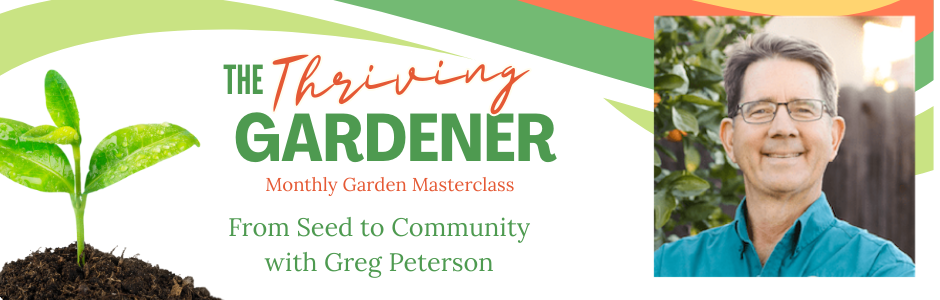
Greg Peterson, founder of UrbanFarm.org and co-founder of Great American Seed Up, lived at his Urban Farm property in Phoenix for 32 years, guided by one inspiring question: “What if there was a garden and fruit tree in every yard?” His work with local seed economies reveals something many of us overlook in our gardening journey. The seeds we choose don’t just determine this season’s harvest. They shape whether our gardens adapt to our unique soil, our specific climate, and yes – even our own hands – over time.
In this Thriving Gardener Masterclass, Greg explores how seeds can become the foundation of a garden that improves year after year – and we’re excited to share these insights with you. But here’s what the article alone can’t show you: the moment-to-moment decisions in Greg’s garden that turned decades of experience into practical wisdom, the tradeoffs he navigated, and the specific varieties that changed everything.
Watch the complete masterclass to discover:
• How seeds can help you grow food for your family and share with others
• Simple ways to let plants naturally reseed so your garden improves year after year
• Which open-pollinated varieties produce reliable, high-yield harvests in home gardens
• How shared seed resources expand what neighborhoods can grow together
• Why locally adapted seeds lead to better flavor, nutrition, and long-term garden success
• Practical ways to join seed sharing, swaps, and neighborhood growing networks
Ready to transform your garden? Register for the full masterclass here.
How Do Seeds Adapt to Your Local Garden Conditions?
Seeds adapt through selection over multiple seasons. When you save seeds from plants that thrived in your specific conditions, you’re selecting for traits that work in your unique space:
• The tomato that handled your summer heat
• The lettuce that didn’t bolt as quickly
• The basil that resisted your local pests
Over several seasons, these small selections compound into something beautiful. Seeds saved year after year can develop traits better suited to your unique growing environment, creating plants naturally more resilient to local conditions. We’ve heard from gardeners in our community who’ve experienced this transformation firsthand – it’s one of those “aha!” moments that makes you fall in love with gardening all over again.
Greg describes this as working with nature instead of against it – a philosophy we wholeheartedly embrace at GYOV. You’re not forcing plants to perform in conditions they weren’t bred for. You’re letting them adapt, and you’re adapting alongside them.
This approach also connects us to something bigger and deeply meaningful. When we save seeds from locally adapted plants, we’re preserving genetic diversity that protects against crop failure from pests or disease outbreaks. Every gardener who saves seeds becomes a guardian of biodiversity. That’s powerful.
How to Save Seeds: Easy Methods for Beginners
The biggest myth about seed saving is that it’s complicated. It’s not.
Dry-Processed Seeds (Easiest for Beginners):
Plants like lettuce, basil, arugula, cilantro, and dill simply need to flower and dry. The process:
1. Let the plant flower and go to seed
2. Wait for seed heads to dry completely
3. Collect seeds into a paper envelope
4. Label with plant name and date
5. Store in a cool, dry place
Wet-Processed Seeds (Slightly More Involved):
Plants like tomatoes, peppers, and cucumbers require wet processing. For tomatoes:
1. Scoop out seeds and surrounding gel
2. Let them ferment in water for 3-5 days
3. Rinse thoroughly
4. Dry seeds completely
5. Store in labeled envelopes
The fermentation removes the gel coating that inhibits germination – it’s nature’s way of preparing seeds for planting.
The real shift isn’t learning a new skill. It’s giving yourself permission to let a few plants go to seed instead of pulling them out. It’s changing how we see our gardens – not just as places of production, but as places of renewal and adaptation.
What Are Community Seed Banks and How Do They Work?
Community seed banks and seed libraries allow gardeners to share locally adapted varieties. Here’s how they strengthen local food systems:
How seed libraries work:
1. Gardeners contribute seeds from plants that did well in their area
2. Other gardeners borrow or take those seeds
3. They grow them and return seeds from their best plants
4. Over time, the collection becomes more adapted to local climate
Benefits of community seed sharing:
• Access to varieties already proven in your climate
• Preservation of genetic diversity
• Shared knowledge from experienced local gardeners
• Reduced cost – seeds are free or low-cost
• Community building around food resilience
Community seed banks harness local knowledge to support gardeners, conserve biodiversity, and help develop varieties adapted to local conditions. We’re not just growing food – we’re building resilience together.
Greg describes this as building a local seed economy, and it connects beautifully with what we believe at GYOV. It’s not just about access to seeds. It’s about creating a system where we support each other, share knowledge, and grow food that’s adapted to where we live. It’s gardening as community building.
Seed swaps work the same way, and they’re genuinely fun! Gardeners bring seeds they’ve saved and trade with others. You leave with new varieties to try (and new friends to make), and the seeds you brought go into someone else’s garden to begin their next chapter.
This kind of sharing expands what’s possible in our neighborhoods and communities. One gardener grows tomatoes well. Another has success with peppers. A third saves lettuce seeds every year. When we share, everyone benefits from varieties that have already proven they can thrive locally. We rise together!
Which Plants Naturally Reseed Themselves in Gardens?
Self-seeding plants that return year after year:
• Lettuce
• Arugula
• Cilantro
• Dill
• Basil (in warm climates)
• Nasturtiums
If you let a few plants go to seed, they’ll drop seeds that sprout the following season. This creates a self-sustaining cycle where the garden keeps giving with minimal intervention.
Why volunteer plants thrive: Plants that successfully reseed are already adapted to your garden’s specific conditions. Over time, you’ll notice these volunteers show up earlier, grow stronger, or resist pests better – that’s adaptation happening in real time.
Greg calls this “letting the garden teach you,” and we think that’s beautiful. You’re not controlling every variable. You’re observing what works and supporting it. You’re becoming a partner with your garden instead of just its manager.
This approach also reduces the work required to maintain your garden – always a win! Fewer seeds to buy. Fewer transplants to start. The garden fills in the gaps on its own, giving you more time to actually enjoy being out there.
How to Start Saving Seeds This Season: Step-by-Step Guide
For beginners, start with 1-2 easy plants.
Best plants for first-time seed savers:
• Lettuce
• Basil
• Cilantro
• Beans
• Peas
Simple seed saving process:
1. Let the plant flower and go to seed
2. Watch seed heads form and dry (this takes several weeks)
3. When fully dry and seeds are loose, collect them into a paper envelope
4. Label specifically: include plant name, variety, and date (example: “Buttercrunch lettuce from shady bed, August 2025”)
5. Store in a cool, dry place
6. Plant next season and observe performance
7. Save seeds again from the best-performing plants
That’s the entire process – and you absolutely can do this.
You don’t need to save seeds from every plant in your garden. You don’t need to master every technique at once. You just need to start small and build the habit, one seed packet at a time. Progress, not perfection!
Greg emphasizes this throughout the masterclass, and it’s something we remind our GYOV community of regularly: Seed saving isn’t about perfection. It’s about participation. Every seed you save is a step toward a garden that’s more adapted, more resilient, and more connected to where you live. It’s also a step toward food autonomy and deeper connection with how your food grows.
Do Locally Adapted Seeds Produce Better Flavor and Nutrition?
Yes. Here’s why local seeds often taste better:
Commercial seed priorities:
• Shelf life
• Uniform appearance
• Ability to survive shipping
• Flavor and nutrition are secondary
Heirloom and locally adapted seed priorities:
• Taste and texture
• Performance in specific growing conditions
• Nutrition
• Freshness (harvested at peak ripeness)
When we grow from locally adapted seeds, we’re prioritizing what truly matters to our families and communities. Flavor that makes you close your eyes and smile. Freshness you can taste in every bite. Nutrition that nourishes our bodies. Plants that thrive in our climate without excessive inputs. This is what gardening should be about!
Greg’s garden in Phoenix is living proof of this. Over decades, he’s grown abundant food in a climate most people assume is too hot for gardening. The key was choosing and adapting varieties that could handle the heat. If he can do it in Phoenix, imagine what’s possible in your garden!
The same principle applies wherever we garden. Seeds that adapt to your conditions produce better harvests with less effort – and more joy in the process.
How to Find Seed Swaps and Seed Libraries Near You
Where to connect with local seed savers:
• Public libraries (many host seed libraries)
• Community gardens
• Local gardening clubs
• Farmers markets
• Online seed networks and forums
• Organizations like Great American Seed Up
What you gain from seed networks:
• Access to rare varieties not in catalogs
• Local favorites already proven in your climate
• Knowledge from gardeners who’ve grown those varieties
• Community support and mentorship
• Collective wisdom that saves years of trial and error
Greg’s work with the Great American Seed Up focuses on making bulk seeds accessible to communities – removing barriers so more of us can participate. The organization provides education on seed saving, hosts events, and helps gardeners connect with local seed resources. It’s building infrastructure for food resilience, one community at a time.
When you join a seed network, you gain access to varieties you wouldn’t find in catalogs – rare treasures and local favorites. You also learn from gardeners who’ve already grown those varieties in your area, saving you years of trial and error. It’s collective wisdom in action!
This kind of community support makes gardening less isolating and more joyful. You’re not figuring everything out on your own in the backyard. You’re part of a vibrant system where knowledge, seeds, and experience flow between people who genuinely want to see each other succeed.
Greg describes this as building culture around seeds, and it resonates deeply with our mission at GYOV. It’s not just about the plants. It’s about the relationships that form when people grow food together, support each other’s learning, and celebrate harvests as a community.
What Greg Peterson’s Masterclass Reveals About Building Resilient Gardens
This article covers the foundation – seeds matter, adaptation happens over time, and sharing strengthens what we can grow together. But we’ve only scratched the surface of what Greg shares!
The full masterclass goes so much deeper, and we think you’re going to find it inspiring.
Greg talks about the concept of a local food economy, explaining how seeds fit into a larger system that includes local farmers, education, and culture. He shares generous stories from his years of urban farming, including what worked, what didn’t, and what he’d do differently. (We love when experienced gardeners share their failures – it’s how we all learn!)
You’ll learn which varieties produce reliable yields in home gardens and how to evaluate seeds for your specific conditions. Greg shares insights from decades of growing food in Phoenix, including lessons about letting plants adapt to their environment. You’ll come away with actionable strategies you can implement this season.
Most importantly, you’ll understand how to make seed saving a natural, joyful part of your gardening rhythm instead of an overwhelming new project. Greg makes it feel accessible, doable, and exciting – exactly how we approach teaching at GYOV.
The masterclass is where the partial insights in this article become a complete blueprint for garden transformation. If you’re ready to grow a garden that improves year after year – and connect with a community of gardeners who share your values – we’d love for you to watch the full conversation with Greg Peterson.
Register for the Thriving Gardener Masterclass and discover how seeds can transform your garden, your food autonomy, and your connection to the community around you. We can’t wait to see what you grow!




Sounds fantastic!