Food independence means freedom from corporate seed monopolies, chemical dependency, and fragile supply chains—built on the interconnected abundance that nature demonstrates in every garden. It’s not about growing all your own food alone; it’s about partnering with nature and connecting with your local community to create resilient food systems that don’t depend on systems that prioritize profit over nourishment.
Independence Day arrives each year with fireworks and flags, celebrating freedom and self-reliance. But if you’ve ever tried to grow all your own food, you’ve probably discovered something nature has been teaching all along.
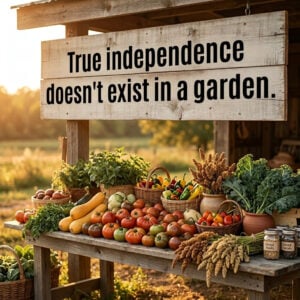
True independence doesn’t exist in a garden.
Your tomatoes depend on earthworms. Your earthworms depend on fungi. Your fungi depend on plant roots. Your plants depend on sunlight, which depends on photosynthesis, which creates the oxygen you’re breathing right now while you read this.
Everything is connected. Everything is mutual.
So when we talk about food independence, we need to get clear on what we’re actually seeking freedom from, and what we’re seeking freedom to build.
Want to explore this idea more deeply? Watch the video where Stacey Murphy walks through her garden and shares what mother nature teaches us about real independence.
Key Takeaways
• True food independence is about connection, not isolation – Your garden thrives through symbiotic relationships between earthworms, fungi, plants, and pollinators
• You’re seeking freedom FROM corporate control, not freedom from community – Seed monopolies, chemical inputs, and fragile supply chains are what home gardeners want to escape
• Local food systems work through specialized abundance and sharing – Grow what thrives in your space, connect with neighbors who grow different things, and build resilience together
• One plant produces more than you could ever need – Nature designs for abundance and backup plans; a single parsley plant can supply your entire neighborhood with seeds for year
The Garden Teaches a Different Kind of Freedom
Stacey Murphy is standing in one of her favorite places (a garden) on Independence Day. And what she sees there teaches a powerful lesson about the web of relationships that makes life possible.
The soil beneath your feet is alive with billions of microorganisms. Earthworms tunnel through, aerating the ground and pulling nutrients up toward plant roots. Fungal networks stretch through the soil like an underground internet, connecting plants and sharing resources across the garden bed.
Above ground, your plants photosynthesize, pulling carbon from the air and sunlight from the sky, converting both into sugars that feed the plant and oxygen that feeds you.
You breathe with your plants. They feed you. You tend them. The cycle continues.
This is the first lesson nature offers about independence: isolation doesn’t work. Connection does.
When you try to grow food in depleted soil without earthworms, beneficial insects, or fungal networks, your plants struggle. When you rely solely on chemical inputs instead of building living soil, you’re fighting nature instead of partnering with it.
The garden doesn’t reward independence from the ecosystem. It rewards participation in it.
What You’re Really Seeking Freedom From
Here’s where the word “independence” starts to make sense again.
When home gardeners talk about food independence, they’re usually not trying to disconnect from their neighbors or refuse help from their local community. They’re seeking freedom from a different system entirely.
They want freedom from:
• Corporate seed monopolies that control what varieties you can grow
• Chemical dependency that depletes soil and requires constant inputs
• Supply chain fragility that leaves grocery shelves empty during disruptions
• Processed foods that prioritize shelf life over nutrition
• Anonymous food systems where you have no idea who grew your food or how
This kind of independence isn’t about isolation. It’s about building local resilience and reclaiming knowledge that used to be common.
According to recent data, 55% of American households engage in gardening activities. The Covid pandemic created 18.3 million new gardeners, most of whom are millennials looking for exactly this kind of autonomy.
They’re not trying to live alone on a mountain. They’re trying to opt out of systems that don’t serve them.
How Local Food Systems Build Real Connection
Once you start growing food, you quickly realize you can’t do it all yourself—, and you don’t need to.
Let’s say you have a sunny backyard. You could grow tomatoes, peppers, cucumbers, and herbs all summer long. More than you could eat yourself.
Your neighbor has a shady yard. Perfect for growing mushrooms, leafy greens, and shade-loving herbs.
Another neighbor keeps bees. Someone else down the street has chickens.
This is how local food systems actually work: through specialized abundance and generous sharing.
You’re not trying to grow every single thing you need. You’re growing what thrives in your space, and you’re connecting with others who are doing the same.
The average garden yields about $600 of produce in a year. But when you start sharing seeds, trading harvests, and learning from each other’s successes and failures, the value multiplies beyond any dollar amount.
You gain knowledge. You build relationships. You create food security that doesn’t depend on a single person doing everything alone.
This is food independence: freedom from corporate control, built on community connection.
The Radical Abundance of One Parsley Plant
Here’s a story that illustrates how nature thinks about independence and abundance.
Last season, a single parsley plant went to seed in the garden. The seed head was massive … covered in hundreds, maybe thousands of tiny seeds.
One plant. One season. Enough parsley seeds to supply an entire neighborhood for years.
Mother nature doesn’t do scarcity. She does abundance with a backup plan.
Even if you mess up the first planting, you have plenty of seeds left. Even if half the seeds don’t germinate, you still have more parsley than you can use. And when those new plants grow and go to seed, the cycle starts again.
This is the kind of independence that actually works: freedom from having to buy seeds from a corporation every single year, built on the generous abundance that one plant freely offers.
You save the seeds. You share them with neighbors. You plant them again next season. You’re no longer dependent on the seed catalog, but you’re deeply connected to the plants, the soil, and the people around you.
💡 Practical Tip: Start with one easy-to-save seed variety this season—lettuce, beans, tomatoes, or herbs like parsley, cilantro, or dill. Let one plant go to seed completely. Collect the seeds. You’ve just taken your first step toward seed independence.
Living for Others Is the Way of Nature
There’s a poem with an unknown author that captures this perfectly:
Nothing in nature is for itself.
Rivers don’t drink their own water.
Trees don’t eat their own fruits.
Sun doesn’t give heat for itself.
Flowers don’t spread fragrance for themselves.
Living for others is the way of life.
This is the pattern you see everywhere in a healthy garden.
The plants don’t photosynthesize just for themselves—they feed the soil microbes through root exudates. The earthworms don’t aerate the soil for their own benefit—they create channels that help plant roots breathe. The flowers don’t bloom solely for beauty—they feed pollinators who then pollinate your vegetables.
The garden works because everything gives more than it takes.
When you grow food, you’re participating in this same pattern. You’re growing more than you need. You’re sharing seeds. You’re teaching a neighbor how to start their first tomato plant. You’re composting your kitchen scraps to feed next year’s soil.
You’re not independent. You’re interconnected. And that’s exactly what makes the system resilient.
What Food Independence Actually Looks Like
So what does real food independence mean for you as a gardener?
• It means learning to save seeds so you’re not dependent on corporations to tell you what to grow.
• It means building living soil so you’re not dependent on chemical fertilizers to feed your plants.
• It means growing food locally so you’re not dependent on fragile supply chains to feed your family.
• It means connecting with other gardeners so you’re not dependent on doing everything alone.
• It means freedom from systems that don’t serve you, built on relationships that do.
This kind of independence doesn’t happen overnight. It develops season by season, as you learn what grows well in your space, as you build soil health, as you save seeds, as you connect with other growers in your area.
But every step you take in this direction is a step toward real food security … the kind that can’t be disrupted by supply chain issues, corporate decisions, or economic instability.
The kind that’s rooted in soil, supported by community, and guided by the wisdom of nature herself.
The Bottom Line: What Food Independence Really Means
Food independence isn’t about doing everything yourself or disconnecting from your community. It’s about freedom from systems that don’t serve you, built on relationships that do. When you save seeds, build living soil, grow food locally, and connect with other gardeners, you create food security rooted in natural abundance and community resilience … not corporate dependency. Your garden already demonstrates this pattern through the interconnected web of earthworms, fungi, plants, and pollinators working together. Real independence means following nature’s model: everything gives more than it takes, and that generosity creates strength that can’t be disrupted by supply chains, economic instability, or corporate decisions.
Start Where You Are
You don’t need to grow all your own food to experience food independence.
You just need to start.
Plant one tomato plant this season. Let one herb go to seed. Share your harvest with a neighbor. Ask another gardener what grows well in your area.
Each small action builds the web of connection that creates real resilience.
Because food independence isn’t about doing it all yourself. It’s about partnering with nature, connecting with the community, and opting out of systems that prioritize profit over nourishment.
Your garden already knows how to do this. The earthworms, the fungi, the plants, the pollinators … they’re all showing you the pattern.
Everything is interconnected. Everything is mutual. And that’s exactly what makes it strong.
Frequently Asked Questions About Food Independence
Can I really grow all my own food?
You don’t need to grow all your own food to achieve food independence. The goal isn’t total self-sufficiency, it’s building resilience through local connections. Most gardeners focus on growing what thrives in their space and climate, then connect with neighbors who grow complementary crops. The average garden yields about $600 of produce annually, and when combined with seed saving, community sharing, and local food networks, you create genuine food security without needing to do everything alone.
How much money does a home garden save on groceries?
The average home garden yields approximately $600 worth of produce in a single growing season. However, the financial benefits multiply when you factor in seed saving (eliminating future seed costs), reduced healthcare expenses from eating fresh organic produce, and the educational value of learning food production skills. When gardeners share harvests and trade with neighbors, the economic value of local food networks extends far beyond individual garden yields.
What seeds are easiest to save for beginners?
Start with herbs like parsley, cilantro, dill, and basil … they’re nearly foolproof. Lettuce, beans, peas, and tomatoes are also beginner-friendly for seed saving. Choose open-pollinated or heirloom varieties (not hybrids) for best results. Simply let one plant go completely to seed, allow the seeds to fully mature and dry, then collect and store them in a cool, dry place. One plant typically produces hundreds or thousands of seeds—far more than you’ll need, giving you plenty to share with your community.
How do I start building a local food network in my area?
Begin by sharing your harvest with immediate neighbors—extra tomatoes, surplus herbs, or saved seeds. Join local gardening groups on social media or community gardens in your area. Attend farmers markets and connect with other growers. Start or join a seed swap in your community. The key is starting small: one shared harvest, one conversation with a fellow gardener, one packet of saved seeds given to a neighbor. Local food networks grow organically from these simple acts of generosity and connection.
What’s the difference between food independence and food self-sufficiency?
Food self-sufficiency implies growing 100% of your food needs alone … an unrealistic and unnecessary goal for most people. Food independence, by contrast, means freedom from corporate-controlled food systems built on community connections and natural abundance. It’s about opting out of seed monopolies, chemical dependency, and fragile supply chains while building local resilience through specialized growing, seed saving, and generous sharing. Independence in this context means autonomy from extractive systems, not isolation from your community.
Ready to hear more about this idea?
Watch the video where Stacey Murphy walks through a garden on Independence Day and shares what mother nature teaches us about interconnection, abundance, and what food independence really means.
Keep Learning With Us on YouTube
Want to see more real-life garden examples, practical growing tips, and seasonal advice from Grow Your Own Vegetables?
Visit our YouTube channel for more videos to help you understand what your garden is showing you, grow with more confidence, and keep learning season by season.
Discover a garden style that’s right for you & your local conditions….
So that gardening takes less time & space than you think!