
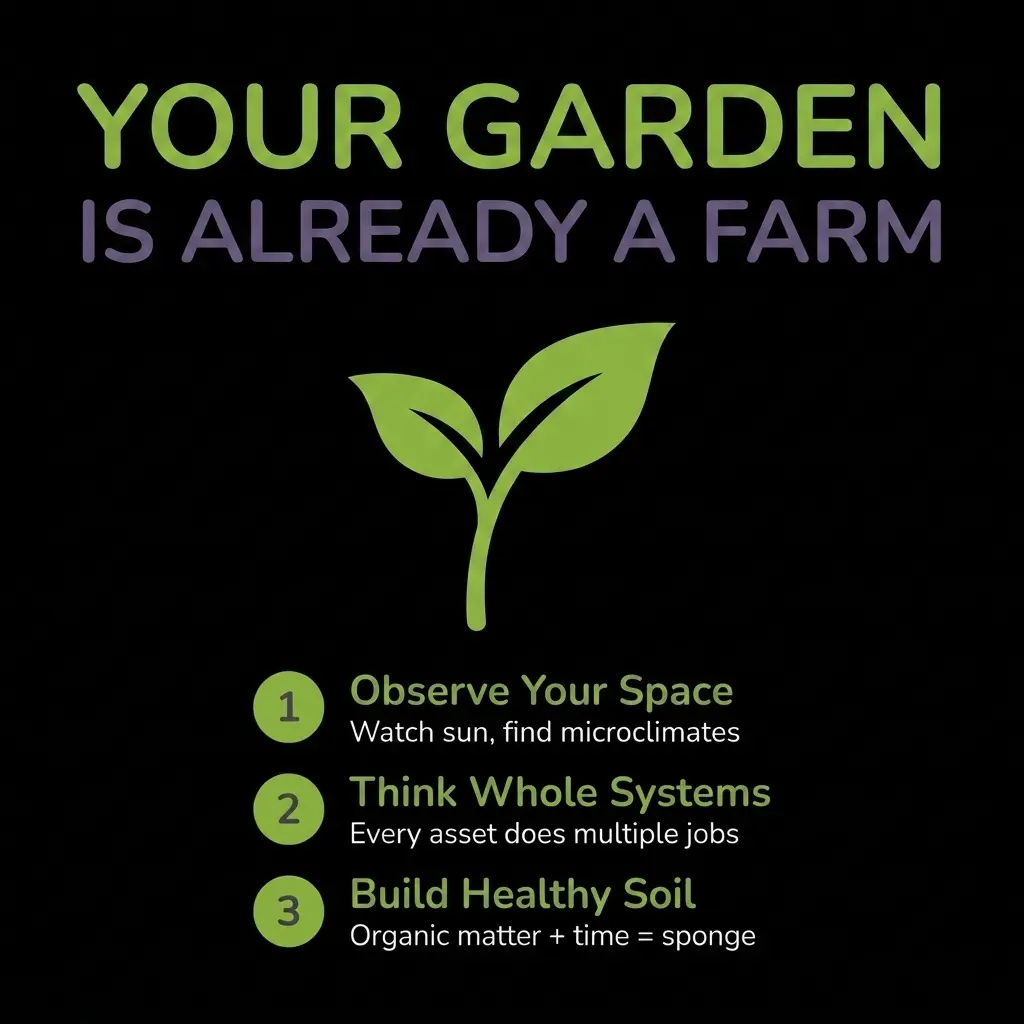
A practical look at regenerative gardening, home food production, and how to grow more food from the space you already have.
If you’ve ever finished a growing season feeling like you gave it real effort and still came up short, you’re in good company. Most home gardeners quietly absorb that disappointment and assume it’s a knowledge problem — something they missed, something they should have done differently. What rarely gets questioned is the system they’re working inside, and whether that system was ever set up to support a thriving, productive garden in the first place.
In a recent Thriving Gardener Masterclass, urban farmer and regenerative gardening educator Greg Peterson reframed that conversation entirely. Greg has grown more than 80 fruit trees on a third of an acre in the middle of Phoenix … one of the hottest, driest cities in the United States. His yard was not a greenhouse experiment or a funded research project. It was a home food production system, built season by season, on the same kind of residential lot that millions of gardeners already have.
The masterclass didn’t offer gardening tips. It offered a different way of seeing, and once you see it, the questions you ask about your soil, your seeds, and your space change completely.
What Greg laid out inside the full training is the kind of framework that doesn’t compress neatly into a short read. The real depth is in learning exactly how a regenerative system comes together over time … not in theory, but in a real yard, in a real climate, with real constraints.
What the article below can’t show you is how Greg’s system actually held up when it was stress-tested — by extreme heat, by real failure, and by the kind of constraints most gardeners face but rarely talk about out loud. That part is in the video.
Most Gardening Advice Is Built on a System That Depletes Over Time
Here’s something worth sitting with: most gardening advice is built on a degenerative model. Inputs go in, plants come out, waste goes in the trash. Next season, you start over and buy more inputs. The soil doesn’t improve. The pest pressure doesn’t ease. The yield doesn’t grow. And the gardener quietly concludes they must be doing something wrong.
Greg names this directly in the masterclass. Degenerative systems are linear. They run in a straight line from resource to waste, and they deplete what they touch. Regenerative systems are circular. They mirror how nature actually works: everything gets used, nothing is discarded, and the system builds itself up rather than running itself down.
This distinction matters for home gardeners because it reframes the fundamental question. The question most gardeners ask is: what do I add to make my plants grow better? The regenerative question is: what is already here, and how do I help it cycle? Those two questions lead to very different gardens.
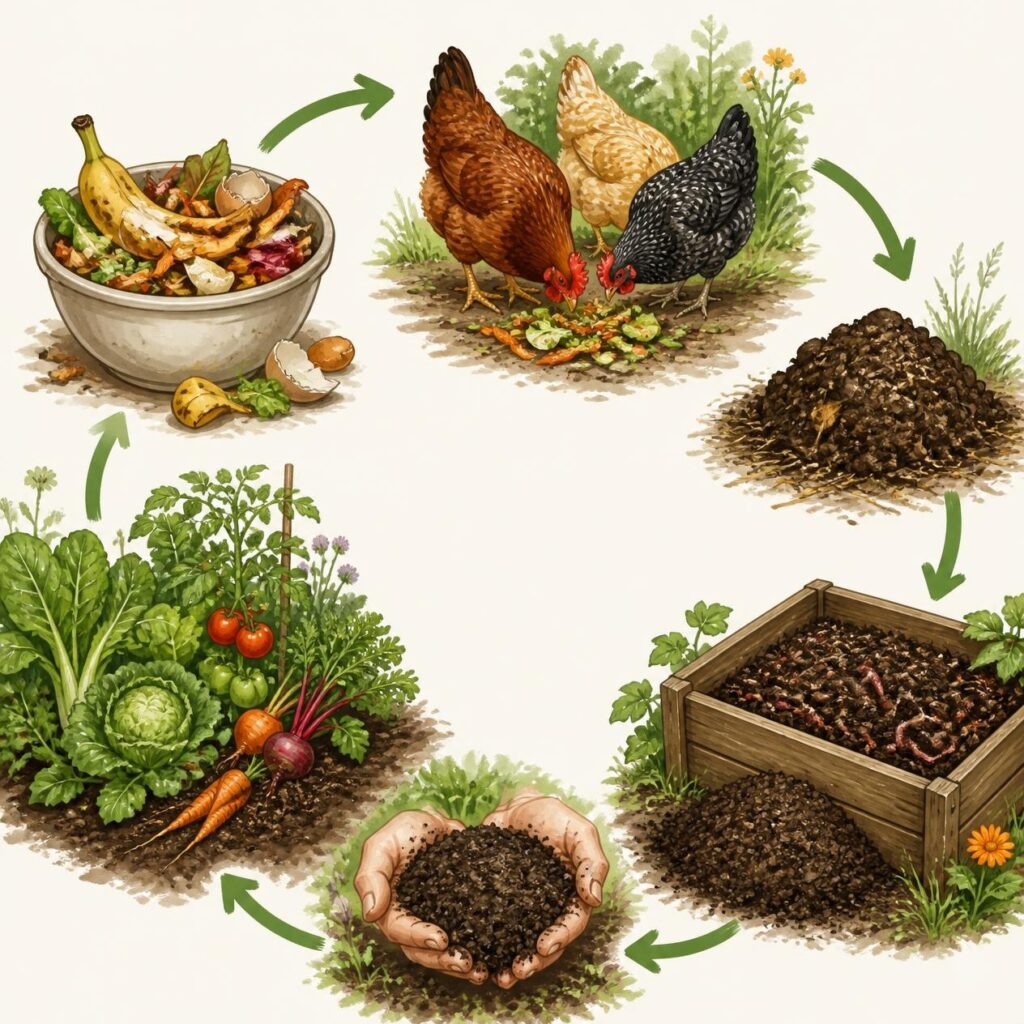
In Greg’s system in Phoenix, food scraps feed chickens, chickens produce manure, manure feeds worms and compost, compost builds soil, soil grows food, and food scraps start the loop again. No step is wasted. No input is purchased twice if the system is designed well. And the soil, far from depleting season after season, becomes richer every year.
That soil eventually absorbed 29,000 gallons of water during a single three-inch rain event — not because of an expensive drainage system, but because 30 years of organic matter had turned it into a living sponge.
Why Healthy Soil Is the Only Shortcut That Actually Works
If there is a single answer to why some gardens thrive and others stall, Greg’s masterclass points directly to the ground beneath the plants. Healthy soil is not just a growing medium. It is a living system, and most gardeners (even experienced ones) are working with soil that isn’t fully alive.
Healthy soil has five components: air space, water, organic matter, dirt, and soil life. Dirt alone (broken-down rock) supports very little. What transforms dirt into soil is the organic matter that feeds the microbial life that, in turn, makes nutrients available to plants. Without that biology, fertilizer becomes a substitute for something the soil should be doing on its own.
A few things Greg points to that signal soil health:
• Mushrooms appearing in your beds are a positive sign, not a problem. They indicate active fungal networks in the soil.
• Water that drains too quickly or pools too long both point to low organic matter. Rich, living soil holds moisture and releases it slowly.
• Plants in healthy soil resist pest pressure better. Bug-resistant plants are not a product, they are the result of the soil beneath them.
Building that soil is not a one-season project. Greg is clear about that. But it also doesn’t require waiting 30 years. Adding generous organic matter (local compost, leaf mulch, worm castings, cover crops left to break down in place) begins changing the biology within a single season. The investment compounds. Each year the soil improves, it requires less external input and produces more food with less effort.
For any home gardener wondering why their vegetable plants look stressed despite regular watering and feeding, this is often the root of the answer. The question isn’t what to spray or pour on top. The question is what’s living underneath.
How to Read Your Garden Space Before You Plant Anything
One of the more unexpected ideas in the masterclass is that the most powerful tool a gardener has is not a product, a technique, or a seed variety. It’s time spent watching.
Greg teaches observation as the first principle of permaculture and regenerative design. Before you plant anything in a new space, spend at least one season watching what that space already does. Where does water pool after rain? Where does the soil dry out first? Where does afternoon shade fall in August versus February? What’s already growing, and what is it telling you about the soil beneath it?
He describes a practice of tracking the sun’s path through your space across different seasons. The sun sits at very different angles in winter versus summer, and that difference determines which corners of your yard stay cold, which walls collect heat, and where your most productive growing zones actually are … as opposed to where you assumed they would be.
He describes using a grapevine trained across an overhead patio structure to bring relief from intense afternoon sun in Phoenix summers. That one observation (and one plant placed intentionally) transformed a space that had been difficult to use into a livable, productive area.
This kind of attention changes what gardeners notice about weeds, too. Weeds are pioneer species. They arrive first and pull nutrients from deeper soil layers. In a regenerative system, they aren’t a failure, they’re free organic matter. Greg pulls them and feeds them to his chickens, who turn them into eggs and manure. The nuisance becomes part of the cycle.
Any Space Can Be a Farm. The Mindset Shift Comes First.
Greg’s definition of an urban farm is straightforward and worth taking seriously: if you grow food and share it with your family, friends, and community, you are farming. The scale is irrelevant. A windowsill with herbs qualifies. So does a balcony, a few raised beds, or a half-acre backyard.
What Greg describes is that most people don’t see themselves as farmers, so they don’t design their spaces the way a farmer would. They plant a little, hope for a little, and accept a little. The act of naming the space is one way to begin changing that relationship with it.
One of the moves Greg recommends to shift that is also one of the simplest: name your farm. His third of an acre in Phoenix became The Urban Farm, and over the years, thousands of people toured it. A name creates intention. It makes the space feel real and purposeful. It invites conversation with neighbors, connects you to a local food economy, and changes how you approach every season’s planning.
That shift … from hobby to farm, from random planting to designed system … is what the masterclass is really teaching. The fruit trees, the chickens, the compost loops, and the water harvesting are all expressions of a mindset that sees the growing space as a whole, living system rather than a collection of individual plants.
If you’ve ever sensed that your garden has more potential than what you’re currently seeing, that instinct is worth trusting. The masterclass doesn’t ask you to overhaul everything at once. It asks you to start seeing your space differently — and that shift, once it happens, tends to change every season that follows.
Does your farm have a name? Drop it in the comments below … even if your farm is three pots on a porch, it counts.
The full training with Greg Peterson is available to watch now. Wherever you are in your gardening journey, there’s something in this conversation that will meet you there.
This is more than a gardening class, this is a new way of thinking about food, resilience, and your relationship with nature.
In this session you’ll discover:
🌱 Understand why growing food where you live matters more than ever.
🏡 Reimagine your garden as an intentional urban farm, regardless of its size.
🌿 Work with natural systems to create a healthier, more abundant growing space.
🍅 Design a productive home farm that supports your family and community.
✨ Create a vision for your growing space and learn why naming it can change everything.




To myself, I’ve always simply called my garden, “Smith Garden,” but during the recent live event with you guys, I felt like something a little more creative, so it became “Hillbilly Ridge.” I’m growing a lot of Appalachian heirloom tomatoes, one variety is called Hillbilly. We live on a ridge, thus the name!