Right now, lettuce is at the center of a public health outbreak that’s worth understanding — and if you grow your own greens, or you’ve been thinking about it, what’s unfolding this summer offers a meaningful reason to look more closely at where your food comes from.
As of mid-July 2026, a microscopic parasite called Cyclospora cayetanensis has sickened over 6,700 people across 34 states, and cases are still being counted. Early investigation results from Michigan point to lettuce and salad greens as a likely source. The parasite spreads through food or water that has come into contact with human feces … most commonly when irrigation water in large commercial growing operations is tainted with human waste. Once it reaches leafy greens with their textured surfaces, it becomes very difficult to remove.
Is it safe to eat lettuce right now? The honest answer is: it depends on where it came from. Washing your produce helps remove surface debris, but it doesn’t fully solve the problem with this particular parasite. Cyclospora is resistant to routine chemical disinfection, and washing alone cannot guarantee its removal. Cooking greens to at least 158°F is one of the more reliable ways to eliminate it, but that’s not always practical with fresh salads. Because symptoms can take up to two weeks to appear after eating contaminated food, people often can’t connect their illness to a specific meal. In an average year, only a small proportion of cyclosporiasis cases are ever traced back to a specific food item and this outbreak is following that same pattern.
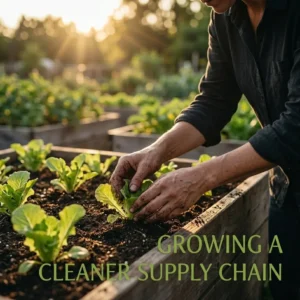
That’s exactly why how you grow (or source) your greens matters more than most gardeners realize. When you grow your own lettuce, even in containers on a porch or a single raised bed in the backyard, you control the water source, the soil, and the growing environment. You’re not depending on a supply chain that spans hundreds of miles and dozens of hands. That’s not a small thing.
But knowing that growing your own is safer is only part of the picture — the real question is how to actually do it well across different garden setups, seasons, and experience levels. The answer is more nuanced than most guides let on.
Grab the free guide and watch the video to help you get started: Grow Your Own Greens: 5 Ways to Put the Most Nutrient-Rich, Organic Greens on Your Plate.
How You Grow Your Greens Determines How Much Control You Actually Have
Not every gardener starts with a full raised bed and a dedicated growing space. And the good news is you don’t need one to meaningfully reduce your dependence on commercially grown greens.
Here’s where different approaches to home gardening each offer real advantages when it comes to food safety and control:
• Container gardening gives you complete control over your growing medium and water source … ideal for balconies, patios, or small urban spaces. Lettuce, spinach, and arugula all thrive in containers.
• Raised beds offer slightly more growing volume and easier management of soil quality, drainage, and spacing … and because you’re building the environment from scratch, you know exactly what goes into it.
• In-ground growing with amended soil gives experienced gardeners the most flexibility for larger harvests, though it requires more attention to water sourcing and soil health over time.
What all three have in common: you become the person who knows your growing conditions. That knowledge is precisely what large commercial supply chains cannot offer consumers.
Why Lettuce and Leafy Greens Are the Best Place to Start Growing Your Own
Greens are one of the fastest crops to grow from seed to harvest … many lettuces and salad mixes are ready in as little as 30 to 45 days. They’re well-suited to containers and raised beds. They don’t require a lot of space. And they’re among the produce items most frequently implicated in large-scale contamination outbreaks, which means growing them yourself delivers an outsized return on the investment of time and effort.
If growing your own isn’t possible right now, sourcing from a local farmer you can speak to directly is the next best step. When you can ask a grower about their water source and field sanitation practices, you’re not just shopping, you’re making an informed choice that most grocery store customers never get the opportunity to make.
Growing Your Own Food Is a Long-Term Answer to a Recurring Problem
Outbreaks like this one cycle through the news and fade, but the conditions behind them don’t change. Contaminated irrigation water, large-scale supply chains, and parasites that are difficult to detect and trace are structural features of how most commercial produce is grown. That’s not a political statement. It’s just how the system works at scale.
Growing even a portion of your own food, starting small, learning what works in your climate and your space, is one of the most grounded decisions a home gardener can make. Not out of fear, but out of care for what you put on your table.
Growing your own greens is one of the simplest ways to know exactly where your food comes from … and it’s easier than you might think. Greens grow fast, don’t need much space, and can give you continuous, easy harvests right outside your door.
We have a free guide and video to help you get started: Grow Your Own Greens: 5 Ways to Put the Most Nutrient-Rich, Organic Greens on Your Plate. It’s a gentle, practical place to begin … whether you have a full garden or just a small corner to work with.
Have Extra Produce? Make It Last.
Whether your abundance comes from a CSA box, the farmers market, or your own garden, a few simple preservation strategies can help you waste less and enjoy fresh food longer.

Join Stacey Murphy’s complimentary masterclass, 3 Strategies to Simplify Preserving & Storing the Harvest, and discover:
• Simple ways to save fresh produce for later
• How to create easy meals from basic garden ingredients
• A practical way to stock your kitchen in just a couple of hours
You’ll also receive a complimentary Quick Guide for Preserving the Harvest.