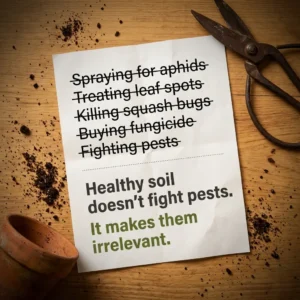
Every gardener knows the feeling. You walk outside and something is eating your plants. The aphids are back. The squash is wilting. The kale has holes in every leaf. So you go to the garden center. You buy a spray. You treat the symptoms. And next week the same problems return.
What if the pests were not the problem? What if they were just messengers telling you something much more important about your soil?
Stacey Murphy ran a network of urban gardens in Brooklyn producing 30 to 60 pounds of vegetables every single week and she kept 90% of all pest, disease, and weed pressure at bay without spraying a single thing. Her success reveals a truth most gardeners never reach because they’re focused on the pest, not the plant: a dying plant attracts pests while a thriving plant naturally repels them.
Your soil fertility plan—your health plan—is your first line of defense. You’re not waiting for symptoms. You’re doing the things that keep your garden healthy.
Video >> Discover 6 Things That Eliminate 90% Of Garden Pests
What Happens When You Skip Compost? A Real-World Case Study
Remember that site where Stacey Murphy was growing a network of urban gardens? She wanted local growers to take over these sites and create a hyper-local food system. The vision was working: one thriving backyard produced 30 to 60 pounds of produce every week for 20 weeks. Neighbors who signed up for the subscription of vegetables received six to eight types of vegetables in their bag, plus herbs and flowers. The soil was healthy, with cover crops about to bloom and rows of overwintered garlic.
When this garden was turned over to a new grower, everything was in great shape. Everyone was optimistic it would go really well. Then, about 8 weeks later, a troubling call came: “Can you come take a look? I’m having some issues with this backyard garden.”
The assessment was a total understatement. There were pest and disease issues on every plant. Everything was dying.
The first question: “Okay, well, where did you get your compost?” The assumption was that maybe the compost wasn’t good enough quality.
The answer stopped everything: “What compost?”
When they had transitioned the site, the new grower thought compost had been applied. The previous manager thought the new grower was applying the compost. It never happened.
This case study reveals everything: A garden that had everything except the 2 inches of compost that were keeping the entire system alive.
How Much Compost Should You Add to Your Vegetable Garden?
Organic farmers have figured out something wonderful: they calculate exactly how much of each nutrient their crops will use during a growing season, then determine how much organic material needs to return through compost to replace those nutrients and keep the soil ecosystem flourishing.
The answer is simple: two inches of decomposed organic matter applied at the start of each growing season.
This isn’t a rough estimate. It’s the precise amount that keeps your soil … and everything living in it … healthy and balanced.
There are billions of microorganisms in a handful of healthy soil. These are what ensure the health of your plants. Your soil is alive. So when your soil is dying, so are your plants. It’s as simple as that. And the dying plants are more prone to diseases and pests.
Growing food takes nutrients out of the soil (the nutrients that end up in our food) and those nutrients have to be replenished. You also need all of that life in the soil to help with that process. Two inches of compost keeps that system alive.
Should You Add Compost Twice a Year?
If you’re growing year-round, you possibly want to apply another 2 inches in the fall because you’re basically doing two rounds of vegetable growing. You want to double down.
You’re asking your soil to support more production, so the nutrient replacement simply needs to match. It’s a rhythm that becomes second nature.
What Type of Compost Is Best for Vegetable Gardens?
Organic farmers typically talk about 2 inches of plant-based compost versus animal manure. If you have animal manure compost, make sure it’s fully composted, then maybe start with just one inch and add a couple handfuls around the plants throughout the season.
Animal manure is more concentrated than plant-based material, so a lighter touch works better, especially for young plants.
If you can make your compost yourself, you know what’s in it. That’s really powerful. You know that you’ve made good compost and it’s all organic.
Do Worm Castings Really Help Prevent Garden Pests?
Here’s what changed the life of many people: Some organic farmers did studies to find out what effects worm poop had on the health of plants, specifically on starting seeds from scratch with the addition of worm poop.
Yes … and the results are remarkable. If you replace up to 10% of the seed starting mix with worm castings (otherwise known as worm poop), the plants that grow from this mixture were 10 times less susceptible to pests and diseases in the field than the plants that didn’t have any worm poop in the seed starting mix.
The other interesting thing: in these tomato plants, they saw better yields with the worm poop.
Here’s what’s interesting about this study: Above 10%, they saw no additional benefits. The sweet spot is exactly 10% worm castings in your seed starting mix.
This matters because worm poop, if you’re buying it, can be expensive. If you’re only putting in 10%, you’re going to save money versus putting in more. Don’t put in any more than you need.
Why Worm Castings Work
You want to use the worm poop up to 10% because it’s full of beneficial bacteria, which is fabulous for building the biology that you want in your soil—the health plan of your soil.
Worms tunnel through the soil and aerate your soil. Adding worm poop to your planting beds can also be very beneficial in keeping your plants pest and disease-free.
If you’re starting your own vegetables and herbs, this is one of the most powerful (and specific!) pieces of advice you’ll find: 10% worm castings in your seed starting mix. Simple, effective, and proven.
What Is the Best Way to Prevent Garden Pests Naturally?
Most gardeners react to pests, seeing aphids and reaching for spray, noticing wilting and adding fertilizer, finding holes in leaves and searching for the culprit.
But there’s a more joyful way to garden.
The best natural pest prevention is healthy soil. When you build healthy soil at the foundation of your garden, you prevent problems before they start. Your soil fertility plan becomes your first line of defense, creating an environment where plants naturally thrive.
The most important thing to understand: when your soil is dying, so are your plants. And the dying plants are more prone to diseases and pests. They come to eat that dying matter as well.
Your soil fertility plan is your first line of defense against pests, diseases, and weeds. You’re not waiting for symptoms of being sick. You’re doing the things that keep your garden healthy.
The Complete Soil Health System for Pest Prevention
Think about where you were at the start of this video: treating symptoms, buying sprays, watching the same pests return week after week.
Now, look at what you know:
Healthy soil is your first line of defense, not your last resort.
2 inches of compost every season is what organic farmers calculate as the precise amount needed to keep soil alive and plants thriving.
10% worm castings in your seed starting mix makes your plants 10 times less susceptible to the pests that destroy most gardens.
This prevention system kept 90% of all pest pressure at bay for years in real-world growing conditions. You are not the gardener who reacts to pests anymore. You are the one who builds the soil before the season starts, who adds the worm castings, who understands that a thriving plant is a pest-resistant plant.
Frequently Asked Questions About Natural Pest Prevention
How does healthy soil prevent pests?
Healthy soil contains billions of microorganisms that ensure the health of your plants. When your soil is dying, so are your plants. Dying plants are more prone to diseases and pests—they come to eat that dying matter. A thriving plant naturally repels pests.
How much compost do I need for a vegetable garden?
You need 2 inches of decomposed organic matter (compost) applied at the start of each growing season. This is the precise amount organic farmers calculate to keep soil alive and plants thriving. If you’re growing year-round, apply another 2 inches in the fall.
What percentage of worm castings should I use in seed starting mix?
Use exactly 10% worm castings in your seed starting mix. Studies show this makes plants 10 times less susceptible to pests and diseases. Above 10%, there are no additional benefits, so you’ll save money by using the precise amount.
Can I use animal manure instead of plant-based compost?
Yes, but adjust the amount. Animal manure compost is more concentrated. Make sure it’s fully composted, then start with just one inch and add a couple handfuls around the plants throughout the season instead of the full 2 inches.
Why do worm castings prevent pests?
Worm castings are full of beneficial bacteria that build the biology in your soil. This strengthens your plants from the root level, making them naturally pest-resistant. The studies on tomato plants also showed better yields with worm castings.
Ready to see this system in action? Watch the complete video above to discover the full six-element prevention framework and exactly how to implement these strategies in your own garden this season.
What’s your biggest pest challenge right now? Share in the comments below—aphids, squash bugs, cabbage worms, or something else? Let’s talk about what you’re facing and how healthy soil might be the answer you’ve been looking for.
Growing Fresh Food Free of Pests
Master Garden Instructor Stacey Murphy is ready to teach you over 40 different strategies to work with Mother Nature instead of against her, so you can grown abundant and healthy fresh food in your own backyard. This course will teach you to:
🌱Learn the difference between various diseases so that you can treat them properly.
🌱Create and execute a plan to help prevent and stop the spread of pests and diseases.
🌱 Discover soil additives that significantly decrease diseases from the start.
🌱Identify beneficial insects so that you do not accidentally kill them.
🌱Create barriers to keep animals from devouring your garden.




Great informational article.
Where should I get my compost if I don’t make it myself?
I can also control aphids with lady bugs. The worst culprit in my yard is Japanese beetles. I have a few rose bushes that I love. I have tried the bacteria-cide powder applied mid-spring, but the major colony is from a neighbor’s yard. Stopping them in just my yard has not worked. The pheromone traps do fill up, but it does not seem to daunt them. I keep the traps well away from the roses so they are not, also, an attractor to my roses. Right now, I pick them off as soon as I can, but the damage is mostly done by the time I can actually see them. I have put leaf mulch, not compost. Would compost help with this??
But HOW do I add it? Two inch layer on top of the soil? Two inches worked into the soil around all the plants?
Biggest issue is squash bugs on rampicante squash in a container.
So MANY eggs I keep removing.
My husband kindly picked up a few young squash plants of different types at a local store. They appeared healthy, but by the following day they were wilted and 2 were gone right down past the first 2 leaves. I applied a dishsoap and water spray and they were greatly improved by the next day. What would cut them off below the first 2 leaves? I thought there might be aphids .
Stink bugs, they sting right through netting bags.