
If garden care often feels like several different jobs competing for your attention, a simple schedule may help you create a calmer rhythm.
A simple weekly garden schedule can divide observation, maintenance, follow-up work, and harvesting across a few manageable sessions. In this sample, gardeners spend one hour on Tuesday, one hour on Thursday, and two hours on Saturday.
You do not need to tend your garden in one particular way. You might schedule 20 minutes before work each morning, or you might complete your garden tasks during a longer Saturday session. The schedule that works best is the one that fits your life.
A weekly garden schedule is a simple way to assign time for observation, soil care, pest and disease notes, planting tasks, compost, harvesting, irrigation checks, and cleanup. The sample Weekly Garden Schedule was created for a garden of approximately 500 to 1,000 square feet.
Begin Each Garden Session With a Purpose
The sample schedule gives each garden visit a clear focus.
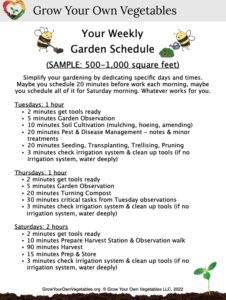
Tuesday includes time to prepare tools, observe the garden, cultivate the soil, address minor pest and disease concerns, and work on seeding, transplanting, trellising, or pruning. The session ends with an irrigation check and tool cleanup. If there is no irrigation system, the schedule recommends watering deeply.
Thursday begins with another short observation period. It also includes time for turning compost and completing critical tasks identified during Tuesday’s observations.
Saturday is centered around harvesting. The schedule includes time to prepare a harvest station, walk through the garden, harvest produce, and prepare or store what was gathered.
This creates three different kinds of garden sessions:
• Tuesday focuses on regular care and plant support.
• Thursday provides time for compost and follow-up tasks.
• Saturday gives harvesting and storage their own space.
Why Does the Schedule Include Garden Observation?
The schedule includes observation at the beginning of each garden session. Tuesday and Thursday each begin with five minutes of observation, while Saturday includes an observation walk as part of preparing the harvest station.
The Thursday schedule also refers directly to completing critical tasks from Tuesday’s observations. This shows how one garden visit can help guide the next one.
You do not need to complete every possible task during every visit. The schedule separates observation from the time set aside for follow-up work.
Which Garden Tasks Are Included Each Week?
The sample schedule includes a mix of short recurring tasks and longer garden projects.
Tool preparation, garden observation, irrigation checks, and cleanup appear throughout the week. Other activities are assigned to particular sessions, including:
• Soil cultivation, such as mulching, hoeing, and amending
• Pest and disease notes and minor treatments
• Seeding, transplanting, trellising, and pruning
• Turning compost
• Harvesting, preparing, and storing produce
The schedule does not suggest that every activity will require the same amount of attention each week. Instead, it provides a place in the routine for each type of garden work.
How Much Time Does the Weekly Garden Schedule Require?
The sample schedule includes one hour on Tuesday, one hour on Thursday, and two hours on Saturday. That adds up to four scheduled hours for a garden of approximately 500 to 1,000 square feet.
The PDF also makes clear that the timing can be arranged differently. You might spread the work into shorter daily sessions or place more of it into one longer block.
The sample is a starting point, not a requirement.
Create a Garden Rhythm That Fits Your Life
A garden schedule can help give different tasks their own time and place. You can use the Tuesday, Thursday, and Saturday structure as written, move the sessions to different days, or divide the work into shorter periods.
Begin with a version that feels realistic. You can then adjust the rhythm to fit the way you prefer to spend time in your garden.
Download the Weekly Garden Schedule PDF for a sample Tuesday, Thursday, and Saturday routine designed for a 500–1,000 square foot garden.
>> Download the Weekly Garden Schedule PDF
This is only a sample, not a fixed formula. The time your garden needs may vary based on its size, the season, what you are growing, and how familiar you are with the tasks. A newer gardener may move more slowly while learning, while an experienced gardener may complete some tasks more quickly. Either way, the schedule is meant to be adjusted rather than followed perfectly.
Frequently Asked Questions
How many hours a week does a vegetable garden take?
The sample schedule allows four hours per week for a 500–1,000 square foot garden, divided across three sessions.
Do I need to work in my garden every day?
Not according to this sample schedule. The work can be divided across Tuesday, Thursday, and Saturday or rearranged into shorter sessions that fit your life.
What should be included in a weekly garden routine?
The schedule includes observation, soil cultivation, pest and disease notes, planting and plant support, compost care, harvesting, irrigation checks, and tool cleanup.
Continue Growing Your Gardening Knowledge
A weekly schedule can help you make time for the garden. The next step is understanding how to plan and care for your garden in a way that supports better harvests.
In the free Grow Your Own Vegetables Masterclass, you’ll learn a practical approach to growing fresh food in the space and time you have available.






Just want to say I Love your website!! Thank you for publishing it!!