Home Gardener’s
Weekly
Issue
No. 126
May
23, 2025

16 Superfoods to Supercharge Your Brain
Did you know there’s a plant so powerful it’s been used to clean up nuclear disaster sites and support brain health?
This sunny flower—with bright yellow petals and a dark brown center—can extract toxic metals and radiation from contaminated soil. But that’s not all…
Its seeds are now gaining attention for their cognitive benefits!
Rich in vitamin E, these seeds help protect brain cells from oxidative stress and may even slow age-related cognitive decline. Some data even suggests that countries where these seeds are regularly consumed have lower rates of Alzheimer’s deaths. (Impressive, right?)
✨ Want to know what it is?
You’ll find it (and 15 other brain-boosting superfoods!) in a free guide you can download now. It’s on page 53—don’t miss it!
🎁 Bonus: When you grab your copy of 16 Superfoods to Supercharge Your Brain, you’ll also get FREE access to The Gut-Brain Solution: New Frontiers, a $297 docuseries featuring 45+ experts sharing powerful tools to support cognitive health through the gut.

Weekly Garden Tip
If you want to plant using the lunar calendar, the waning moon is the time to harvest, fertilize, improve soil, mulch, prune, etc.
Typically, no seeding is done during the waning moon, but some people do transplant.

Free Resource

Got Aphids? Your Guide to Aphid Management teaches you how to prevent and control aphid infestations using Integrative Pest Management (IPM). Learn about the aphid life cycle, natural prevention strategies, and effective mechanical and biological controls. When necessary, discover organic sprays to use as a last resort. With prevention at the core, this guide will help you tackle aphid problems the smart, eco-friendly way.

🥕 BLOG 🥕
3 Strategies to Prevent Pests & Diseases Organically – Early in the Growing Season
Want to keep your garden healthy without relying on harsh chemicals? Start early this growing season with these 3 organic strategies to prevent pests and diseases. From improving soil health with compost to choosing pest-resistant varieties and harvesting regularly, these simple steps will help protect your crops naturally and set your garden up for success!

What: Remedy: Ancient Medicine for Modern Illness
Who: Sacred Science
When: Airing Now!
Most people exploring food as medicine focus on healthier eating and superfoods—but they often miss the next level: herbal medicine.
Herbs offer powerful, natural solutions for stress, hormone imbalances, low energy, and more—building vitality and resilience every day.
Join Remedy: Ancient Medicine for Modern Illness, a FREE documentary series with 42 experts sharing the most effective herbal remedies for today’s health challenges.
Take the next step in your healing journey—naturally!

This week at the LIVE Q&A we covered garlic growing, proper crop rotation, capsicum problems and more!To view the sneak peek, log into your portal and click here.
🍅🥕🌽🫐🍆🌱 Get your questions answered and keep moving forward on your fresh food goals in Harvest Club! 🍅🥕🌽🫐🍆🌱
Not a member of our garden membership Harvest Club? You can get a one-time complimentary two-month membership with any of our courses. Harvest Club has tons of resources to help you thrive. Plus, you get access to ongoing garden support through email. Learn more here.


Dear Arti:
Question: I would like to know if you can plant clover as a ground cover between rows of pole beans and tomatoes as a weed suppressant. If so, will it affect the plants by taking too much nutrients out of the soil? Thanks! – Jim G., OH
Answer: Hi Jim,
Great question! So here’s the thing: you can use clover to plant in between to suppress the weeds, but there are a few things to consider.
First, there are many types of clover and some grow pretty tall. That might shade out some of the sunlight your plants need. Therefore, I would choose a clover with a shorter growth habit.
Second, pole beans and clovers are both nitrogen fixers. These plants take nitrogen from the air and put it into the soil. Generally this is a good thing. However, when your tomatoes are trying to fruit, if there is too much nitrogen in the ground, the tomatoes will opt for the nitrogen and continue producing leaf material. To mitigate this, you might do something like plant a row of lettuces or other leaf crop in between the tomatoes and the clover to help pull up some of the nitrogen.
—————————————————————————————
Question: How do I get rid of voles/moles – with no pesticides or other things that will hurt people. – Kathryn P.
Answer: Hi Kathryn,
Great question!
Just in case anyone reading this doesn’t know, moles are actually a beneficial in almost all cases. Usually when we see ground damage we blame moles, but usually it’s voles or other burrowing animals.
Moles usually live individually, so you’ll almost always just see one. It is rare to find a gathering of more than one or two moles.
Moles are insectivores, so they don’t damage plants. Occasionally a plant will be toppled by accident, but the benefit they provide can be worth the few plants that get toppled, as moles eat grubs and other pests that burrow deeper into the soil than we can get to.
Voles are a different story. Not only do they eat plant matter, but they also carry human diseases, so we definitely don’t want them around our food.
For smaller, more burrowing rodents like voles and mice, you’ll need barriers below and above ground where the holes in the fence are no bigger than dime size. Anything bigger than that and they can squeeze through.
There are many different strategies for this type of fencing. The one that seems to work the best is to get quarter-inch hardware cloth. You want the hardware cloth 2 feet down and 1 foot horizontally. So, if you make an L shape where the bottom of the L heads into the garden, that’s ideal.
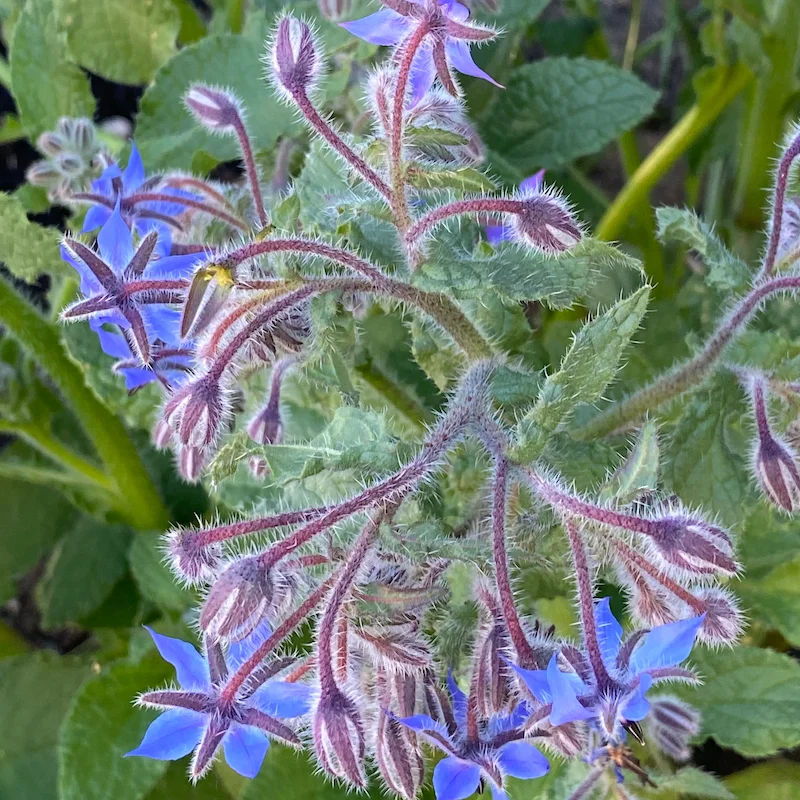
These companion plants not only look lovely together but also support a healthy, thriving ecosystem.